

You’ve probably already heard that India’s bullet train project is finally picking up speed — but if you’ve been following the headlines without a clear picture of what’s actually happening on the ground, you’re not alone. The Sabarmati-Surat section is the most advanced stretch of the entire Mumbai-Ahmedabad High-Speed Rail corridor, and it’s closer to reality than most people realise. In this guide, we’ll break down exactly where construction stands, when trains could run, what tickets might cost, and why this 222-kilometre stretch matters far beyond Gujarat.
Key Takeaways
- The Sabarmati-Surat section spans approximately 222 km through Gujarat, covering six major stations: Sabarmati, Ahmedabad, Anand, Vadodara, Bharuch, and Surat.
- India’s first bullet train trial runs are targeted for 2026, with partial commercial operations on the Surat-Bilimora stretch expected by August 2027.
- Overall project physical completion exceeded 55% as of early 2026, with Gujarat significantly ahead of Maharashtra in construction progress.
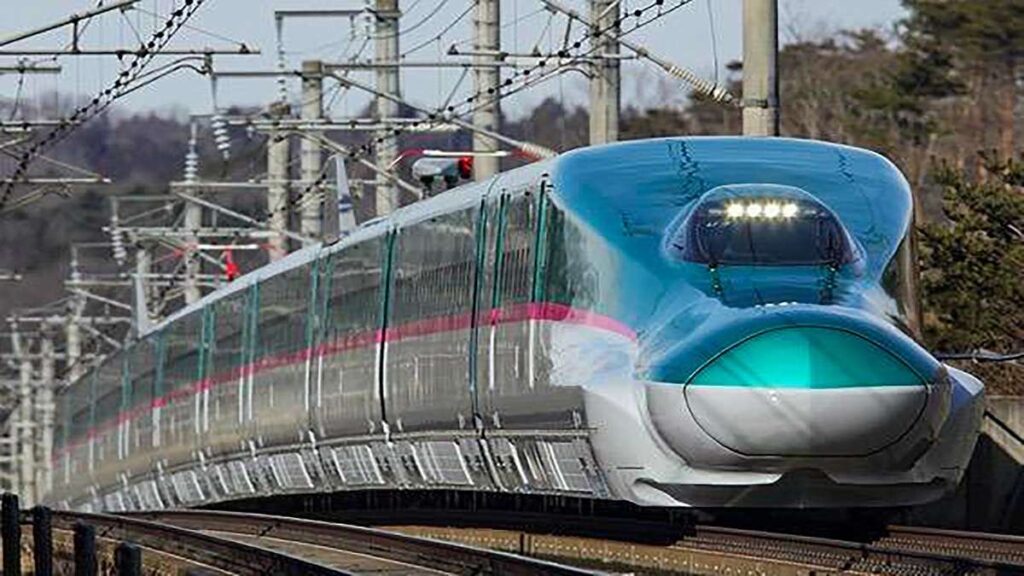
- Trains will operate at 320 km/h using Japanese E10 Shinkansen technology, cutting Ahmedabad-Surat travel time to under 40 minutes.
- Projected ticket fares range from ₹1,500 to ₹4,000 one-way depending on class, positioned as premium yet competitive with domestic air travel.
- The total project cost has escalated to ₹1.98 lakh crore, funded primarily through an 81% JICA soft loan from Japan.
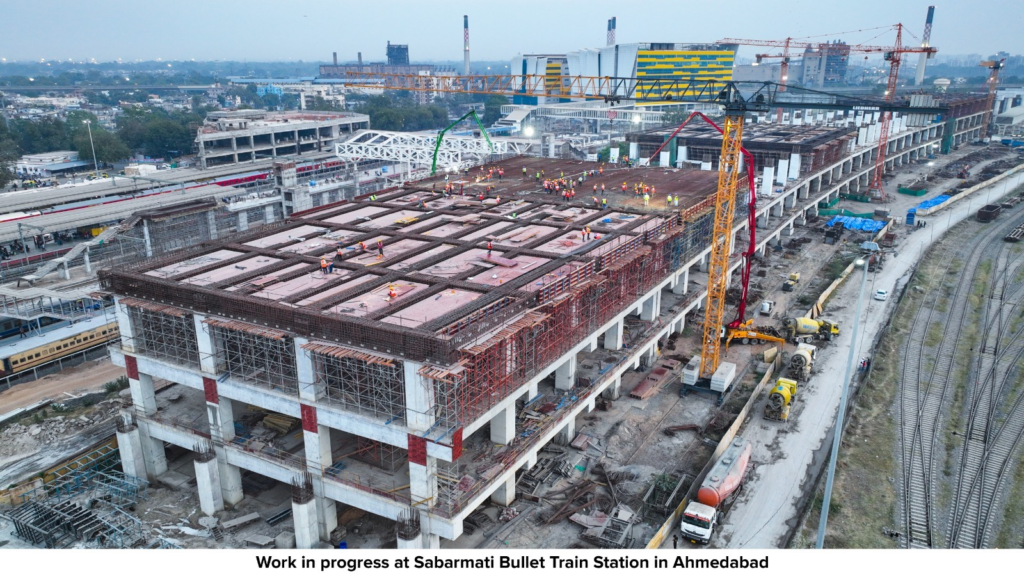
- Sabarmati station is designed as a 9-storey multi-modal hub, integrating high-speed rail with metro, BRT, and conventional Indian Railways services.
What Is the Sabarmati-Surat Bullet Train Section?
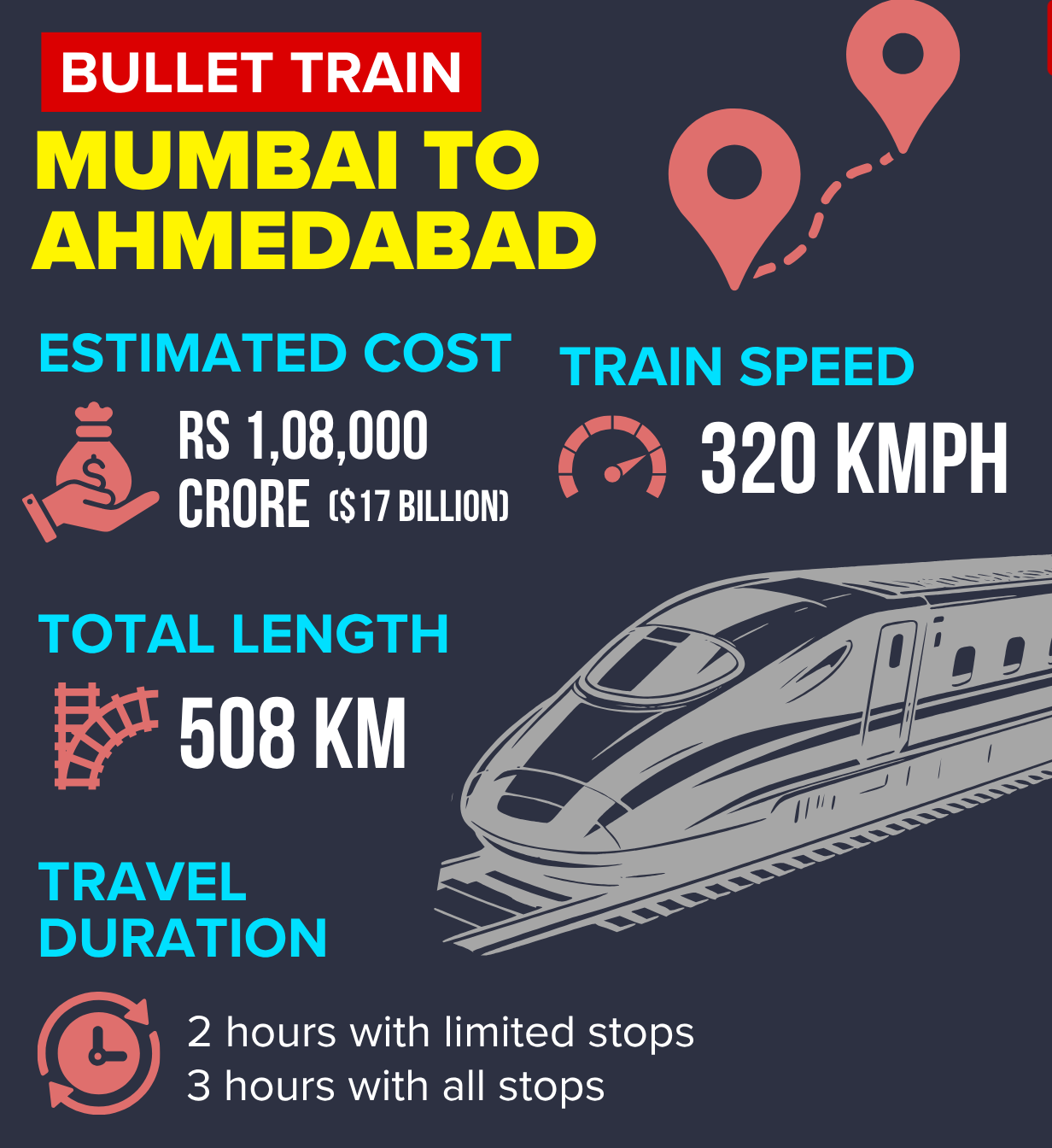
The Sabarmati-Surat bullet train section is the northern Gujarat segment of India’s first high-speed rail corridor, the 508-kilometre Mumbai-Ahmedabad High-Speed Rail (MAHSR) project, connecting Sabarmati near Ahmedabad to Surat across approximately 222 kilometres at speeds of up to 320 km/h.
This stretch forms the operational backbone of Phase 1 of the MAHSR project. Unlike the southern sections running through Maharashtra — where land acquisition delays have slowed progress — the Gujarat segment has benefited from smoother right-of-way approvals, making it the frontrunner for India’s first commercial bullet train service.
The MAHSR corridor as a whole covers 12 stations across 508 km from Mumbai’s Bandra Kurla Complex to Sabarmati. Gujarat accounts for 352 km of that distance. The Sabarmati-Surat stretch, at roughly 222 km, represents the densest urban-industrial belt on the corridor — linking two of Gujarat’s largest economic centres.
The project is being executed by the National High Speed Rail Corporation Limited (NHSRCL), a joint venture of the Ministry of Railways, the Government of Maharashtra, and the Government of Gujarat. Japan’s E10 Shinkansen technology, supplied under a bilateral cooperation agreement between India and Japan, forms the technological foundation of the project.
Why Does the Sabarmati-Surat Corridor Matter for India?
The Sabarmati-Surat bullet train corridor matters because it represents India’s first real-world deployment of high-speed rail technology, with the potential to reshape business travel, freight logistics, and urban development across one of the country’s most industrially productive regions.
Gujarat’s economic weight makes this stretch strategically critical. Surat is India’s diamond and textile capital, handling a significant share of the country’s textile exports. Ahmedabad is a major financial, pharmaceutical, and logistics hub. The corridor connecting them carries some of the highest inter-city passenger volumes in western India.
For context, conventional trains between Ahmedabad and Surat currently take approximately 2 to 2.5 hours for the roughly 265-kilometre journey. The bullet train is designed to cover the comparable distance in under 40 minutes — a reduction that fundamentally changes the calculus of same-day business travel between the two cities.
Moreover, this project carries significant geopolitical and economic signalling value. The MAHSR is the flagship infrastructure collaboration between India and Japan, supported by a soft loan of approximately ₹88,000 crore from the Japan International Cooperation Agency (JICA) at an interest rate of approximately 0.1% per annum. Its success — or delay — has implications for future bilateral infrastructure partnerships.
Read Also :
What Is the Current Construction Status of the Sabarmati-Surat Section?
Construction on the Sabarmati-Surat section is the most advanced portion of the MAHSR project, with overall corridor-wide physical completion surpassing 55% as of early 2026, driven heavily by progress in Gujarat.
Viaduct and Formation Work
As of January 2026, 334 km of viaduct construction and 417 km of formation work have been completed across the full corridor. The MAHSR is predominantly an elevated railway — approximately 85% of the 508-km route runs on elevated viaducts, totalling 465 km — and Gujarat accounts for the bulk of completed structures.
Pier construction across the corridor had crossed 392 km by late 2025, with girder launching completed over 300 km. The Sabarmati-Surat belt, benefiting from flat terrain and cleared land parcels, has progressed faster than any comparable stretch.
River Bridges and Critical Structures
17 of 25 major river bridges across the full corridor have been completed, with the Gujarat sections — including crossings over the Narmada, Tapti, and Mahi rivers — at the forefront. All nine bridges between Vapi and Surat were completed by late 2024, clearing the path for track-laying in that sub-section.
The alignment also crosses National Highway 48 at multiple points, requiring complex elevated interchange structures. These have been largely addressed in the Gujarat segment.
Land Acquisition
Total land acquisition stands at 1,389.5 hectares corridor-wide. Gujarat’s land parcels were acquired significantly earlier than Maharashtra’s, removing a key bottleneck. This asymmetry in land clearance is the primary reason the Gujarat sections — including Sabarmati-Surat — are positioned to become operational years before the full corridor is complete.
Rail Welding and Electrification
Rail welding operations commenced in 2024 along completed stretches. Electrification work, using the 25 kV AC overhead catenary system standard for Shinkansen operations, has begun in advanced sections. Signalling and train control systems, based on the Digital Automatic Train Control (D-ATC) technology used on Japan’s Shinkansen, are in procurement and early installation phases.
What Are the Key Stations on the Sabarmati-Surat Route?
The Sabarmati-Surat bullet train route serves six major stations — Sabarmati, Ahmedabad, Anand, Vadodara, Bharuch, and Surat — each designed as integrated multi-modal transport hubs rather than standalone rail terminals.
Sabarmati: The Northern Multi-Modal Terminal
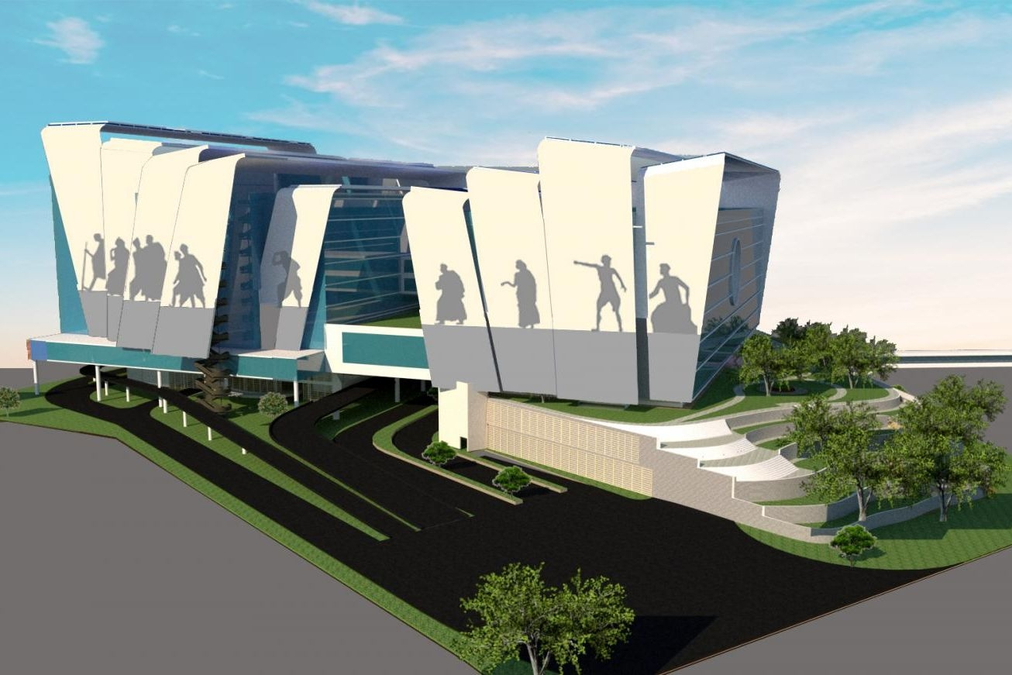
Sabarmati station is the northern terminus of the MAHSR corridor, designed as a nine-storey multi-modal hub integrating high-speed rail with the Ahmedabad Metro, Bus Rapid Transit (BRT), and existing Indian Railways services. The station’s vertical integration is intended to eliminate last-mile connectivity friction — a known challenge for high-speed rail adoption globally.
The scale of the Sabarmati hub positions it as one of the most complex transport interchange projects in India. Its design draws from multi-modal benchmarks at stations like Shin-Osaka and Tokyo in Japan, where seamless transfers between rail services drive ridership above single-mode projections.
Surat: The Industrial Gateway
Surat station is among the most strategically located on the Gujarat segment, situated at the edge of one of India’s fastest-growing cities. Prime Minister Narendra Modi inspected construction progress at Surat station, signalling the political priority attached to this location.
Surat is also the anchor for the Surat-Bilimora sub-section — the first operational stretch planned within the MAHSR project, covering approximately 47 to 50 kilometres, with trial runs targeted for 2026 and commercial operations for August 2027.
Intermediate Stations: Anand, Vadodara, Bharuch
Anand, Vadodara, and Bharuch serve as intermediate stops between Sabarmati and Surat. Vadodara, as Gujarat’s third-largest city and a major industrial centre, is expected to be one of the highest-ridership stations on the sub-corridor. Bharuch, positioned between Surat and Vadodara, anchors the chemical and petrochemical industrial belt along the corridor.
What Is the Phased Launch Timeline for Sabarmati-Surat Operations?
The bullet train launch on the Sabarmati-Surat section follows a phased commissioning strategy, with partial operations on the Surat-Bilimora stretch targeted for August 2027 and full Sabarmati-Surat services expected by approximately 2028.
Phase 1: Surat-Bilimora (2026–2027)
The Surat-Bilimora stretch of approximately 47 to 50 km is the designated first operational segment. Trial runs are being targeted for 2026, with commercial inauguration planned for August 2027 — a date that carries symbolic significance given its proximity to India’s Independence Day.
This phased approach mirrors the commissioning strategy used in Japan and China, where short initial segments are opened for operational learning before full-corridor services begin.
Phase 2: Surat-Vapi Extension (2027)
The Surat-Vapi stretch of approximately 100 km is the next planned extension, with its inaugural run also targeted for August 2027. Vapi sits at the Gujarat-Maharashtra border, making this extension a staging milestone before Maharashtra sections are ready.
Phase 3: Full Sabarmati-Surat Operations (2028)
Full operations between Sabarmati and Surat — covering all six stations across 222 km — are projected for approximately 2028, contingent on track-laying, signalling commissioning, and rolling stock delivery timelines being met.
Full Corridor Completion (2029)
The entire 508-km Mumbai-Ahmedabad corridor is targeted for completion by December 2029, though this timeline remains dependent on resolving residual land acquisition challenges in Maharashtra and completing the undersea tunnel section near Mumbai’s Bandra Kurla Complex.
| Phase | Stretch | Distance | Target Year |
|---|---|---|---|
| Phase 1 | Surat – Bilimora | ~47–50 km | August 2027 |
| Phase 2 | Surat – Vapi | ~100 km | August 2027 |
| Phase 3 | Full Sabarmati – Surat | ~222 km | ~2028 |
| Full Corridor | Mumbai BKC – Sabarmati | 508 km | December 2029 |
How Fast Will Bullet Trains Run Between Sabarmati and Surat?
Bullet trains on the Sabarmati-Surat section will operate at a maximum speed of 320 km/h using Japanese E10 Shinkansen technology, reducing travel time between Ahmedabad and Surat to under 40 minutes compared to the current 2-plus hours by conventional rail.
The E10 Shinkansen trainset — the technology base for India’s bullet trains — is among the most refined high-speed rail platforms in the world. Japan’s Shinkansen network has operated since 1964 with a fatality record of zero due to train accidents, a benchmark that informs the safety architecture being built into MAHSR.
For the full Mumbai-Ahmedabad journey, the projected travel time is approximately 2 hours and 7 minutes, compared to the current fastest train time of roughly 7 hours. The Sabarmati-Surat sub-section, at 222 km, is projected to take under 40 minutes at operational speed.
The alignment is designed with minimal curves and grade separations to sustain high speeds throughout. The 85% elevated viaduct design eliminates at-grade crossings entirely — a key engineering prerequisite for 300+ km/h operations.
What Will Bullet Train Tickets Cost Between Sabarmati and Surat?
Projected ticket prices for the Sabarmati-Surat bullet train service range from approximately ₹1,500 to ₹2,500 for standard class and ₹2,500 to ₹4,000 for premium or executive class one-way, though official fares have not yet been announced by NHSRCL.
These estimates are based on distance-based pricing models discussed for the MAHSR corridor, benchmarked against Japanese Shinkansen fare structures adjusted for Indian market conditions. For reference, the fastest conventional AC train fares between Ahmedabad and Surat currently range from approximately ₹800 to ₹1,200 — placing projected bullet train fares at roughly two to three times the existing premium rail price point.
Dynamic pricing is expected, with higher fares for peak departure slots and potential discounts for advance bookings, group travel, or off-peak services — a model consistent with both Japanese Shinkansen and Indian Railways’ current Vande Bharat pricing approach.
For context, one-way airfare between Ahmedabad and Surat is rarely available given the short distance — making the bullet train a category creator rather than a direct competitor to aviation on this sub-corridor specifically.
Are Fares Designed for Cost Recovery?
NHSRCL’s financial model targets cost recovery over 25 to 30 years on the ₹1.98 lakh crore project investment, supported substantially by the JICA soft loan at approximately 0.1% annual interest. Fares alone are not expected to cover full capital costs in the near term; the model depends on a combination of fare revenue, transit-oriented development monetisation around stations, and ancillary commercial revenues.
Achieving 70% or higher seat occupancy is considered a key threshold for operational viability in early years, a benchmark drawn from NHSRCL’s ridership planning documents.
What Are the Ridership Projections for the Sabarmati-Surat Service?
NHSRCL projects 18,000 to 23,000 daily passengers corridor-wide in initial operating years, with the Sabarmati-Surat section expected to capture 40 to 50% of that demand — approximately 7,000 to 12,000 passengers per day — given the density of the Ahmedabad-Surat urban-industrial corridor.
Passenger mix projections indicate that business travellers will constitute approximately 50% of ridership, followed by tourists at 30% and daily commuters at 20%. This breakdown reflects the economic character of the corridor: Surat’s diamond, textile, and chemical industries generate substantial inter-city business travel to Ahmedabad and Vadodara on a regular basis.
Long-term ridership is projected to reach approximately 1.1 lakh passengers per day corridor-wide by 2035, assuming full operations and transit hub development around stations
For context, conventional trains between Ahmedabad and Surat currently carry an estimated 20,000+ daily passengers, providing a meaningful baseline demand signal. Converting even a fraction of this existing passenger base, combined with induced demand from reduced travel times, supports the medium-term ridership targets.
The Surat-Bilimora Phase 1 stretch — the first segment to go operational — targets a more conservative 5,000+ daily riders post-2027 launch, reflecting the limited initial catchment of a 47-km sub-section.
What Is the Total Cost of the MAHSR Project and How Is It Funded?
The total cost of the Mumbai-Ahmedabad High-Speed Rail project has escalated to approximately ₹1.98 lakh crore, up from the original estimate of ₹1.08 lakh crore, primarily due to a four-year delay caused by land acquisition challenges and the COVID-19 pandemic.
Funding structure:
- 81% (approximately ₹88,000 crore) — JICA soft loan at ~0.1% per annum interest over 50 years
- Remaining equity — split between the Ministry of Railways (50%) and the Governments of Maharashtra and Gujarat (25% each)
As of mid-2025, approximately ₹78,839 crore had been spent on the project, with Gujarat sections accounting for a disproportionately high share of expenditure given their construction lead over Maharashtra.
The cost escalation — nearly double the original estimate — has drawn scrutiny from infrastructure analysts and parliamentary committee reviews. However, given the JICA loan’s highly concessional terms, the effective financing cost remains low by infrastructure project standards. — Source: Parliamentary Standing Committee on Railways reports
What Are the Key Challenges Facing the Sabarmati-Surat Section?
The primary challenges facing the Sabarmati-Surat bullet train section include completing rolling stock procurement and import timelines, finishing signalling and electrification work, and ensuring that the broader Maharashtra sections do not delay the phased Gujarat launch through administrative or funding bottlenecks.
Land acquisition in Maharashtra remains the most significant unresolved risk to the full corridor timeline. While Gujarat’s land parcels are cleared, the Mumbai-side sections — including the complex undersea tunnel — face ongoing challenges that could affect the overall project schedule without directly impacting the Gujarat-first phased approach.
Rolling stock import timelines are a logistical variable. Shinkansen trainsets need to be manufactured in Japan, shipped to India, and subjected to extensive trial runs before commercial certification. The 2027 launch target depends on these imports arriving and clearing trials on schedule.
Passenger adoption in the early years presents a demand-side challenge. At projected fare levels of ₹1,500 to ₹4,000, the bullet train targets a premium segment. Building the habit of high-speed rail travel in a market accustomed to significantly lower rail fares requires sustained marketing and a demonstrably reliable service from Day 1.
What’s Next for the Sabarmati-Surat Bullet Train Project?
The immediate next milestones for the Sabarmati-Surat section include completing track-laying on the Surat-Bilimora sub-section, commissioning electrification on cleared stretches, and beginning rolling stock import procedures for trial operations targeted in 2026.
For travellers and businesses in Gujarat, the practical next step is monitoring NHSRCL’s official communications for fare announcements, station facility details, and trial run schedules. Official ticket booking is expected to open closer to commercial launch.
For policymakers and urban planners, the focus should be on transit-oriented development around the six Sabarmati-Surat stations — the window for land-use planning around these hubs is narrowing as construction progresses.
For investors and developers, the Surat and Sabarmati station catchment areas are attracting increasing attention for commercial and mixed-use development, with the multi-modal hub designs explicitly intended to anchor new urban nodes around each station.
Conclusion
The Sabarmati-Surat bullet train section is no longer a distant promise — it is an infrastructure project in advanced construction, with a credible 2027 partial launch timeline, verified engineering progress, and a clearly defined phased commissioning plan. At 55% physical completion corridor-wide and Gujarat significantly ahead of that average, the foundations for India’s high-speed rail future are visibly in place.
The 222-kilometre Sabarmati-Surat stretch will not just move passengers faster. It will restructure the economic geography of Gujarat, compress business travel times that currently cost hours into journeys measured in minutes, and demonstrate — for the first time on Indian soil — what high-speed rail can actually deliver.
Whether you’re a frequent traveller between Ahmedabad and Surat, a business operator planning logistics, or simply someone tracking one of India’s most consequential infrastructure bets, this corridor deserves your attention. The bullet train is coming to Gujarat — and the timeline, for once, is getting closer rather than further away.