



You’ve probably already seen the praise for Dhurandhar — the production design, the action sequences, the performances. But there’s a reason this film holds your attention for three-plus hours that almost no one is talking about: its screenplay architecture. In this breakdown, we’ll explain exactly how Aditya Dhar constructed a story where every event is earned, every character is introduced with purpose, and nothing — not a single scene — exists without a reason.
Key Takeaways
- Dhurandhar’s screenplay is built on cause and effect — every major plot development is the logical consequence of a previous action, not a random twist.
- Aditya Dhar introduces every major character through tragedy, which creates immediate emotional investment before the plot demands it.
- Hamza’s journey from passive observer to active agent is the structural spine of the film — and it is constructed over three hours with deliberate patience.
- Characters are introduced through social links, not exposition — the screenplay earns each new face through the existing world rather than announcing them.
- The story operates on three levels of power — street, underworld, and mastermind — and moves its protagonist through each level organically.
- The film’s climax, the 26/11 Mumbai attacks, is not a surprise — it is the inevitable destination of a chain of decisions that began at a milk shop in Lyari.
- Storytelling symmetry — Hamza ultimately kills Rehman using the same method Rehman once used — gives the film a structural completeness rare in mainstream Hindi cinema.
What Is Cause-and-Effect Storytelling, and Why Does Dhurandhar Use It So Well?
Cause-and-effect storytelling is a narrative structure in which every event in a film is the direct result of a preceding action, creating a logical chain that the audience can follow and anticipate without being able to predict. It is the oldest and most durable principle in dramatic writing, and it is the primary reason Dhurandhar works at the scale it does.
Most mainstream action films rely on twist-based storytelling — where surprise is the primary mechanism of engagement. The risk of that approach is well known: if the audience has no investment in the setup, the twist lands hollow. Dhurandhar takes the opposite approach. Director Aditya Dhar prioritises inevitability over surprise. By the time the film reaches 26/11, the audience does not feel shocked — they feel the weight of a chain of events that could not have ended any other way.
For a story to feel cohesive, every effect must have a visible cause somewhere earlier in the narrative. The strength of a screenplay is often measured not by how unexpected its turns are, but by how logical they feel in retrospect. On that measure, Dhurandhar is among the most tightly constructed Hindi films in recent memory.
Why Does Dhurandhar’s Opening Work So Effectively?
The opening sequence of Dhurandhar works because it establishes both a character and a logic in the same moment — and that logic governs everything that follows.
The film begins with Ajay Sanyal. We see him watching a plane. The music is unsettling. There is talk of negotiations and terrorists. When he boards and sees blood, the film cuts to the past — not as a stylistic choice, but as a narrative one. We understand immediately that Sanyal has seen this before. He is not a newcomer to this world; he is a veteran re-entering it.
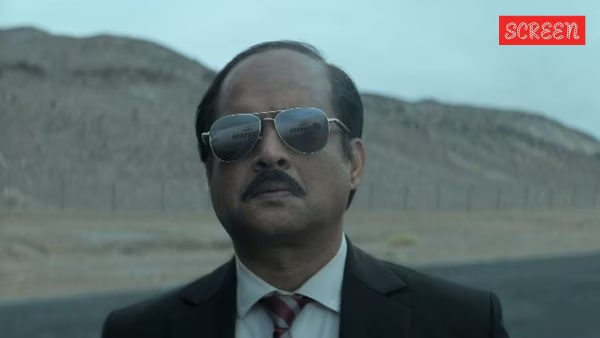
The plane hijacking sequence establishes the film’s central mechanism: the incomplete mission. Sanyal is stopped from acting. He cannot finish the job. Some terrorists survive. Those survivors return. They attack Parliament. The fact that he was prevented from acting — that early restraint — is the direct cause of everything the film sets in motion. The approval of Operation Dhurandhar is not a bureaucratic decision; it is the effect of a failure that we witnessed in the first act.
This is a particularly sophisticated structural choice. Most spy thrillers begin with a mission being authorised. Dhurandhar begins with the consequences of a mission that was denied — which means the audience enters the story already understanding what is at stake if the protagonist is stopped again.
How Does Aditya Dhar Introduce Characters Without Exposition?
Aditya Dhar introduces characters through tragedy rather than information, a technique that creates emotional investment before the plot requires it.
This is one of the most consistent and disciplined choices in the screenplay. Consider the two most important character introductions in the film.
Hamza: The Stranger in a Land of Shadows
Hamza — played by Ranveer Singh — enters Pakistan’s Lyari Town without dialogue and without announcement. He is shown being beaten on the street. He cries while eating biryani alone. For a film starring one of Hindi cinema’s most charismatic performers, this is a deliberately anti-heroic introduction — and it is entirely intentional.

By presenting Hamza as passive and vulnerable in his first act, the screenplay preserves the impact of his eventual agency. The audience does not know what he is capable of. They only know that something is being done to him. When he finally acts with full force, the contrast is the payoff. A character who enters the film already dominant has nowhere to go. A character who enters the film on the back foot has the entire story ahead of him.
The classic literary term for this device is “a stranger in a land of shadows” — a new observer entering an already-established world, so that the audience experiences the world through their eyes. Harry Potter in Diagon Alley. Bond arriving in a new city. The device works because discovery and experience happen simultaneously for character and audience.
Rehman Daku: The Villain Who Grieves
Rehman Daku is introduced not as a gangster, but as a father who has just lost his son — and his wife slaps him for it. This single scene accomplishes more characterisation than a ten-minute exposition sequence could. He is powerful, but he is not in control. He is feared, but he can be shamed. He loves his children in a way that will later be turned against him.

The tragedy-first introduction is significant because it prevents the audience from reducing Rehman to a function — a villain to be defeated. He is a man with grief, ego, and vulnerability. That complexity is what makes the film’s third act carry weight. When Hamza ultimately has to destroy him, the audience understands what is being lost, not just what is being won.
How Does the Film Build Its World Without Briefing-Room Exposition?
Dhurandhar avoids the most common failure of spy films — the PowerPoint briefing scene — by constructing its world through social links rather than information transfers.

The milk shop run by Alam Bhai is the film’s structural hub in its first half. It is the space through which every character introduction passes. Alam introduces Hamza to Lyari. Alam introduces Hamza to Rizwan. The shop connects the street level of the story to its underworld level without anyone having to explain how the world works — the audience simply watches characters move through it.
The most technically impressive moment of this approach is the introduction scene between Hamza and Rizwan. They already know each other. They are colleagues. But when Alam introduces them, neither reacts. They play strangers. This moment tells the audience three things simultaneously: that Hamza is a trained intelligence operative, that Rizwan is too, and that they operate under a discipline of minimal exposure. The screenplay shows us the rules of their world rather than stating them.
From the milk shop, the chain extends outward:
- A mission to protect Rehman’s son fails — but Hamza saves a second son, making himself useful to Rehman.
- Rehman’s trust opens the door to the Khanani Brothers.
- The Khanani Brothers lead to Major Iqbal.
- Major Iqbal is the mastermind behind 26/11.
Every character in the film is connected to every other character through a chain of actions, not through coincidence or narrative convenience. The story started at a milk shop. It ended at a national tragedy. The distance between those two points is built brick by brick across three hours.
| Character Level | Key Players | How They Are Introduced |
|---|---|---|
| Level 1 — Street | Alam Bhai, Hamza, local gang | Through the milk shop and street violence |
| Level 2 — Underworld | Rehman Daku, Uzair Baloch, Jamil Jamali | Through tragedy and social proximity |
| Level 3 — Masterminds | Major Iqbal, Khanani Brothers | Through the trust Hamza earns at Level 2 |
Why Does Hamza Stay Passive for So Long — and Why Does That Work?
Hamza’s passivity in the first half of the film is a deliberate structural choice that makes his eventual transition to active agent the film’s most satisfying payoff.
For the first two acts, Hamza does not initiate. Things happen to him, and he responds. He is beaten. He is introduced to people. He saves someone without planning to. He is brought into circles he did not force his way into. Even saving Rehman’s son — the act that defines his standing in the underworld — is framed as a reactive response rather than a calculated move.
This passivity serves two narrative purposes. First, it makes Hamza trustworthy to the characters around him — a man who follows and supports, rather than one who pushes for position, is less threatening to the powerful men he is trying to infiltrate. Second, it makes him trustworthy to the audience — we accept his presence in spaces where he should not be, because he has never appeared to want to be there.
The turning point is 26/11. The Mumbai attacks represent the moment at which Hamza can no longer afford to observe. His country has been attacked. His mission is no longer about gathering intelligence — it is about preventing the next catastrophe. From this point, he begins to act with intention. He marries Jamali’s daughter to secure power. He cultivates Jin’s support. And finally, he engineers Rehman’s death in a way that maintains his cover — appearing to try to save him while ensuring he cannot survive.
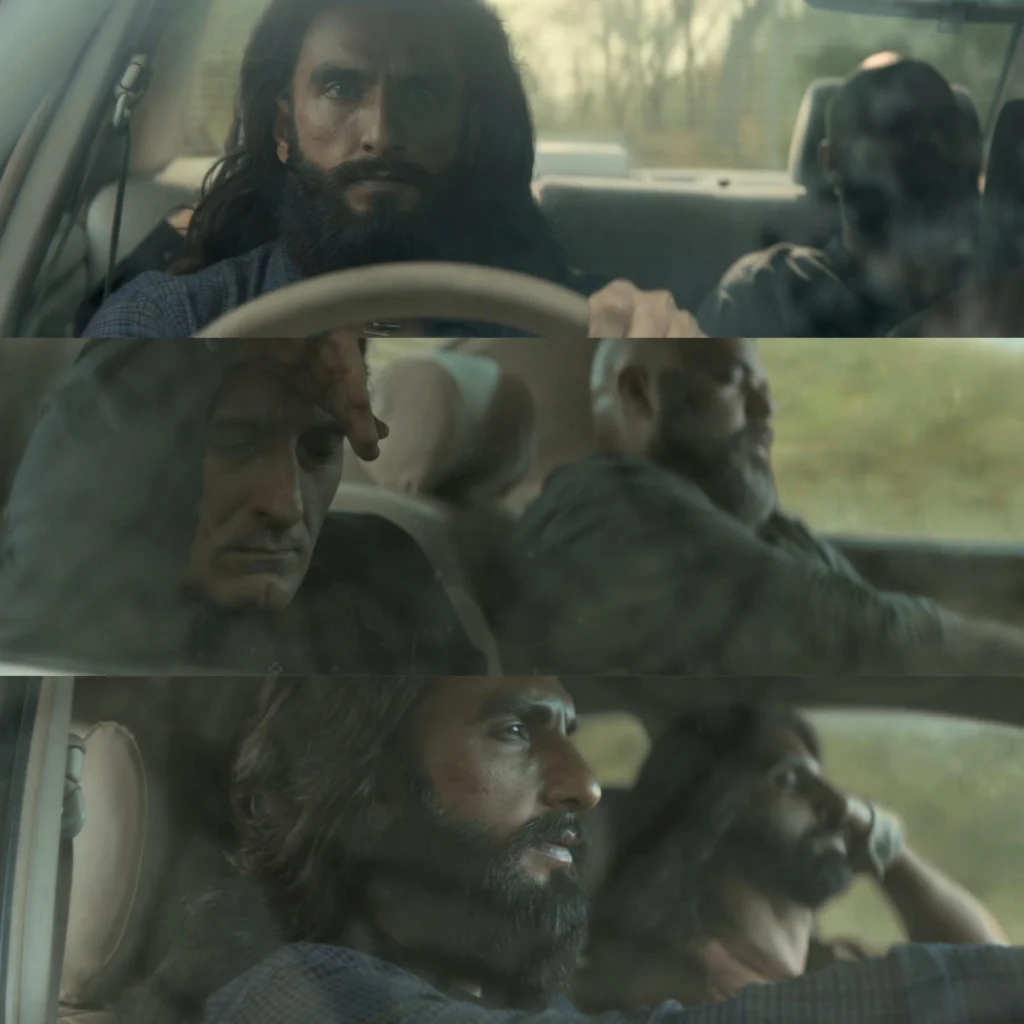
That final kill mirrors the first tragedy precisely. Rehman once arranged the death of his own son when that son became a liability. Hamza ends Rehman’s life using the same logic — creating a situation in which he appears to have tried and failed. The circle closes. The symmetry is not decorative; it is the culmination of a story that has been building this echo since its opening frames.
What Can Screenwriters Learn From Dhurandhar’s Structure?
Dhurandhar demonstrates that the most engaging long-form screenplays are built on character motivation chains, not plot twists — a principle that applies equally to commercial cinema and prestige drama.
For writers working in any form, several practical lessons emerge from how Aditya Dhar has constructed this film.
First, establish your cause before your effect. Every major development in Dhurandhar has a setup — sometimes placed thirty or forty minutes before the payoff. The patience required to plant a detail and wait for its return is the discipline that separates structurally sound writing from event-driven storytelling.
Second, introduce antagonists as humans before introducing them as threats. Rehman Daku grieving his son is a more frightening character than Rehman Daku firing a gun — because the grief tells us what he is capable of when something he loves is threatened. Complexity in antagonists is not a concession to moral ambiguity; it is a mechanism for raising stakes.
Third, let your protagonist earn their position. Hamza does not become the Number 2 in Rehman’s operation because the screenplay needed him there. He becomes Number 2 because he saved Rehman’s son, which was itself the consequence of a failed original mission, which was the consequence of Hamza’s street-level positioning, which was the consequence of his assignment. The chain is traceable all the way back to the beginning.
Also Read:
What’s Next: How to Watch Dhurandhar With Its Architecture in Mind
The best way to appreciate Dhurandhar on a second watch is to track the cause-and-effect chain rather than the plot. Rather than following what happens, follow why it happens.
Start with the question: what is the very first cause in this story? It is Sanyal being stopped. Everything else flows from there. As you watch, ask yourself — for each major development — what earlier action made this possible? By the end of the film, you will have traced a single unbroken chain from a plane on a tarmac to the streets of Mumbai.
Pay particular attention to the moments when Hamza chooses not to act. These are the scenes that carry the most structural weight, because they are the scenes in which the story is being saved for later. Every passive choice Hamza makes in the first half is a deposit that the screenplay draws on in the second.
For those interested in screenplay craft more broadly, Dhurandhar belongs in the same conversation as Andhadhun, Gangs of Wasseypur, and Talvar — Hindi films that demonstrate how cause-and-effect architecture, executed with discipline, can sustain audience attention for durations that most commercial films cannot.
Conclusion
Dhurandhar is not a long film that happens to be good. It is a long film because its story requires that length — because the chain of causes and effects that leads from a hijacked plane to 26/11 cannot be compressed without breaking. Aditya Dhar has built a screenplay in which every character, every scene, and every choice serves the structure. The result is a film that feels smooth not because it avoids difficulty, but because every difficulty has been earned.
The next time someone asks why a three-hour film kept them riveted, the answer is not the action, or the stars, or the production design. The answer is architecture. And Dhurandhar‘s architecture is among the most carefully constructed in recent Hindi cinema.