


You’ve probably seen the headlines about ultra-fast EV charging — but most of them describe lab conditions that don’t survive real-world use. The 2026 BYD Denza D9 is different: it pairs a production-ready second-generation Blade Battery with a premium three-row MPV cabin, and its charging claims are backed by official manufacturer specifications, not projections. In this guide, we cover everything confirmed about the refreshed Denza D9 — battery technology, powertrain options, interior layout, pricing, and what it all means for buyers.
Key Takeaways
- The 2026 BYD Denza D9 features the second-generation Blade Battery, capable of charging from 10% to 70% in just 5 minutes under standard conditions.
- Six variants are available at pre-sale, spanning PHEV and BEV configurations, priced from 389,800 to 489,800 yuan (approximately $51,500 to $64,700 USD).
- The BEV flagship variant delivers up to 800 km of CLTC range, while the PHEV version offers a pure electric range exceeding 400 km.
- Cold-weather charging performance is notably strong — at -20°C to -30°C, a 20% to 97% charge takes approximately 12 minutes.
- All variants include Denza’s God’s Eye 5.0 intelligent driving assistance system, with existing D9 owners receiving the upgrade via over-the-air update.
- Pre-sales opened March 29, 2026, with dealership deliveries expected in April and 18 months of complimentary flash charging included with pre-sale orders.
- The Blade 2.0 battery offers a 30% increase in energy density over the first-generation system, improving both efficiency and range across all variants.
What Is the BYD Denza D9 2026?
The BYD Denza D9 2026 is a refreshed premium multi-purpose vehicle (MPV) from BYD’s Denza sub-brand, available in both plug-in hybrid and battery electric variants, and built around the company’s second-generation Blade Battery technology. It sits in the upper segment of China’s fast-growing premium electric MPV market, competing on the strength of its powertrain technology, cabin comfort, and intelligent driving features.
The Denza brand operates as BYD’s premium vehicle division, positioned above BYD’s mainstream lineup and targeting family and business buyers who prioritise interior space, long-range capability, and advanced technology. The D9 is the brand’s flagship model, and the 2026 refresh represents the most significant update to the platform since the vehicle’s original launch.
Pre-sales for the 2026 model opened on March 29, 2026, with deliveries to dealerships expected in April. Pre-sale orders include 18 months of complimentary flash charging — a meaningful incentive given the vehicle’s ultra-fast charging capability.
Why the Blade 2.0 Battery Makes the Denza D9 2026 Significant
The second-generation Blade Battery in the Denza D9 2026 represents a meaningful advance in production EV battery technology, combining ultra-fast charging speeds, improved energy density, and robust cold-weather performance in a single system that is available today in a production vehicle.
EV battery technology has long faced a trilemma: fast charging, high energy density, and thermal stability are difficult to achieve simultaneously in a mass-market cell design. BYD’s first-generation Blade Battery addressed safety and longevity concerns effectively. The second generation, as deployed in the Denza D9, extends the platform into fast-charging territory that was previously associated only with smaller, less energy-dense cell formats. The Blade 2.0 battery delivers a 30% increase in energy density compared to its predecessor, a figure confirmed in BYD’s official product specifications.
For buyers, this matters beyond the headline charging speed. Higher energy density means more range from the same physical battery volume — which is why the D9 BEV achieves up to 800 km of CLTC range without requiring a physically larger pack.
The fast-charging performance also has practical implications for long-distance travel. A 5-minute charge from 10% to 70% — under confirmed standard conditions — represents a refuelling stop comparable in duration to a conventional fuel stop, removing one of the most persistent practical objections to BEV adoption in the premium MPV segment.
What Are the Full Specifications of the Denza D9 2026 Blade 2.0 Battery?
The Denza D9 2026 Blade 2.0 battery is available in short-blade and long-blade configurations, with performance specifications varying by application and variant. The figures below are drawn from BYD’s confirmed official specifications.
Charging Speed: What 5-Minute Charging Actually Means
Under standard conditions, the Blade 2.0 battery charges from 10% to 70% in approximately 5 minutes, and from 10% to 97% in approximately 9 minutes. These figures represent confirmed manufacturer specifications for the short-blade configuration used in the Denza D9.
In cold conditions, performance remains strong relative to most competing systems. At both -20°C and -30°C, charging from 20% to 97% takes approximately 12 minutes — an increase of roughly 3 minutes over standard-condition performance. For an MPV targeting family and business buyers in markets with significant winter conditions, this cold-weather charging resilience is a practically relevant specification, not merely a marketing point.
Conventional AC charging is reported to be 30 to 50% faster than standard AC charging systems, further improving the vehicle’s day-to-day home-charging practicality.
Range: PHEV and BEV Performance Figures
| Variant | Motor Configuration | CLTC Range | Key Spec |
|---|---|---|---|
| PHEV (all trims) | 1.5T + 200kW front + 45kW rear | 400+ km electric | 6.35 L/100km depleted |
| BEV Single Motor | 340kW front | 750 km | Front-wheel drive |
| BEV Dual Motor | 340kW front + 70kW rear | 800 km | AWD configuration |
The PHEV variants combine a 1.5-litre turbocharged engine producing 115 kW with a dual-motor electric system — 200 kW at the front axle and 45 kW at the rear. The system uses the second-generation Blade battery in short-blade configuration and achieves a CLTC pure electric range exceeding 400 km, with a fuel consumption of 6.35 litres per 100 km on a depleted battery. For buyers who need genuine long-distance range without range anxiety, this PHEV specification is among the most capable in the premium MPV segment.
What Does the 2026 Denza D9 Interior Look Like?
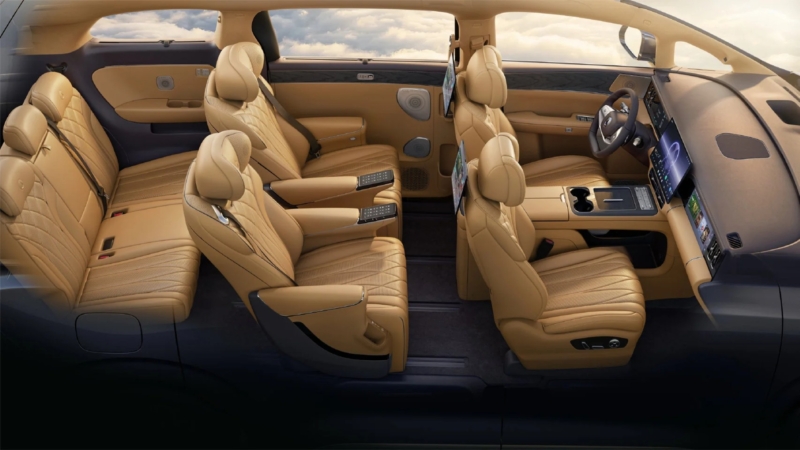
The 2026 Denza D9 interior adopts a T-shaped dashboard layout across a three-row configuration, designed to serve both family transport and business passenger scenarios with equal capability.
Front Cabin and Driver Interface
The front cabin features a standard instrument cluster paired with a central control screen, supplemented by a dedicated display for the front passenger. This dual-screen front arrangement is consistent with the broader direction of premium Chinese EV interiors, prioritising information availability for both occupants rather than a driver-only focus.
The overall dashboard architecture is clean and oriented around the central T-shaped console, which organises primary controls within natural reach of the driver without cluttering the visual field.
Second-Row: Aviation-Style Seating and Integrated Screens
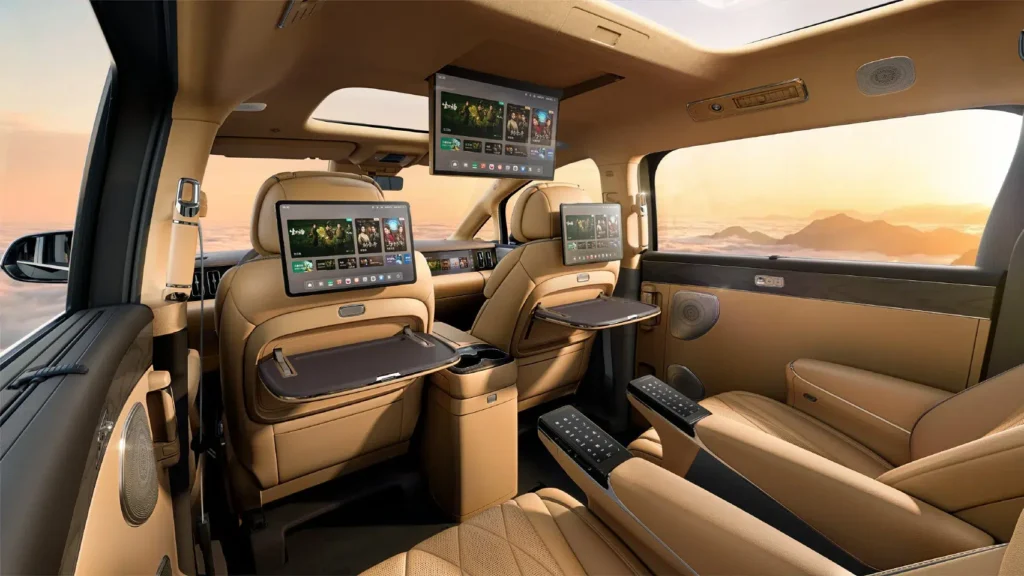
Second-row occupants in the Denza D9 2026 have access to aviation-style seats with foldable tray tables, supplemented by two seatback-mounted displays, a roof-mounted entertainment screen, and armrest-integrated control displays for in-seat adjustments.
This level of second-row amenity positions the D9 directly against premium MPVs used for business passenger transport — a segment in China where rear-seat comfort and productivity features carry significant purchase weight. The combination of independent screens, physical tray tables, and seat-level controls creates a self-contained rear environment that does not require interaction with the front cabin for basic comfort and entertainment functions.
Three-Row Layout and Overall Dimensions
The D9’s three-row layout measures 5,250 mm in length, 1,960 mm in width, and 1,900 mm in height, with a wheelbase of 3,110 mm. These dimensions place it firmly in large MPV territory, providing genuine space for all three rows rather than a nominal third-row addition. The long wheelbase is a structural advantage for rear-passenger legroom — the specification most scrutinised by business MPV buyers.
What Is the Denza God’s Eye 5.0 Driver Assistance System?
Denza’s God’s Eye 5.0 is the intelligent driving assistance system included as standard across all 2026 Denza D9 variants, representing the latest generation of BYD’s advanced driver assistance platform for the Denza brand.
God’s Eye 5.0 covers the full range of modern ADAS functions expected in the premium segment, including highway and urban intelligent driving assistance, automated parking, and lane management capabilities. Notably, BYD has confirmed that existing Denza D9 owners will receive a full over-the-air software upgrade to the 5.0 system — a meaningful ownership benefit that extends the value of earlier purchases and signals confidence in the platform’s hardware compatibility.
For buyers evaluating the D9 against competing premium MPVs, the standard inclusion of God’s Eye 5.0 across all six variants — rather than reserving it for flagship trims — is a meaningful differentiator.
How Much Does the 2026 BYD Denza D9 Cost? Full Pricing and Variants
The 2026 BYD Denza D9 is offered in six variants at pre-sale prices ranging from 389,800 to 489,800 yuan, equivalent to approximately $51,500 to $64,700 USD at current exchange rates.
| Variant | Pre-Sale Price (Yuan) | Pre-Sale Price (USD approx.) |
|---|---|---|
| PHEV Flash Premium | 389,800 | ~$51,500 |
| PHEV Flash Prestige | 429,800 | ~$56,700 |
| PHEV Flash Flagship | 489,800 | ~$64,700 |
| EV Flash Premium | 389,800 | ~$51,500 |
| EV Flash Prestige | 429,800 | ~$56,700 |
| EV Flash Flagship | 489,800 | ~$64,700 |
The pricing structure mirrors the PHEV and BEV lineups at equivalent trim levels, giving buyers a direct powertrain choice without a price premium for either configuration at the entry and mid-tier levels. The flagship variants of both PHEV and BEV carry the same ceiling price of 489,800 yuan.
Pre-sale orders placed before the April dealership launch include 18 months of complimentary flash charging — a benefit valued in practical terms given the D9’s ultra-fast charging capability and the ongoing build-out of high-power charging infrastructure.
What Does the Denza D9 2026 Look Like on the Outside?
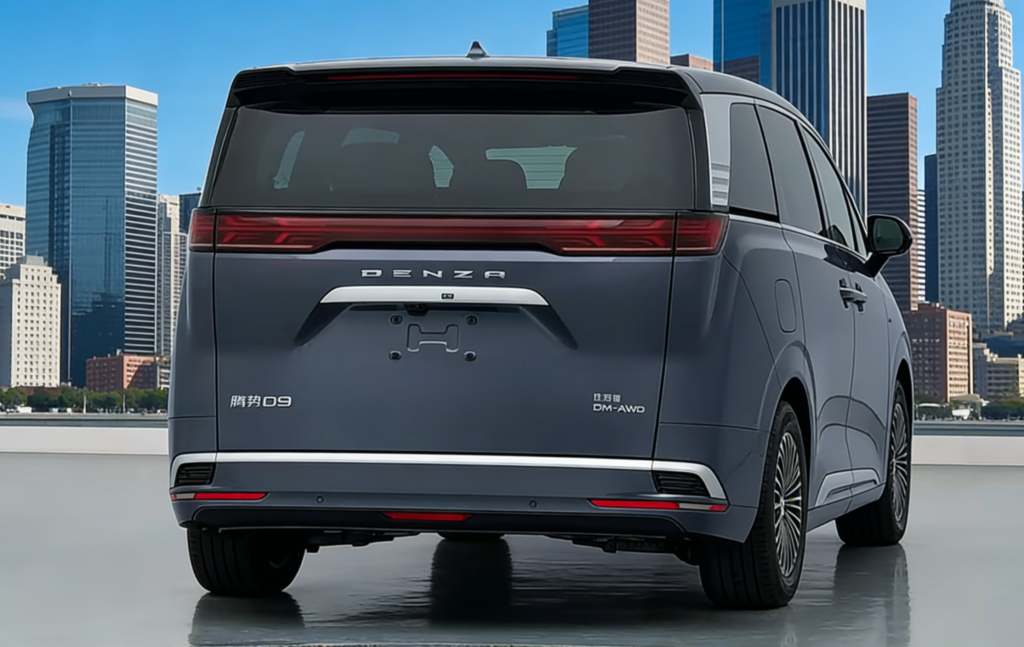
The 2026 Denza D9 exterior features a redesigned front grille with added chrome trim, creating a more layered, three-dimensional appearance while retaining the diamond-cut styling theme of the current generation.
The vehicle maintains its dual-tone bodywork and long, streamlined profile from the A-pillar to the D-pillar — a proportional continuity that preserves the D9’s established visual identity while updating its surface detailing. At the rear, arrow-shaped LED taillights span the full width of the vehicle, incorporating a multi-layer light source structure designed for a pronounced visual effect at night and in low visibility.
The front fascia update also appeared in a Ministry of Industry and Information Technology regulatory filing for the EV variant — a standard pre-launch disclosure process in China that confirmed the exterior changes ahead of the official reveal.
Practical Tools for Comparing the Denza D9 Against Competing Premium MPVs
The most effective way to evaluate the 2026 Denza D9 against competing premium MPVs is to compare across four dimensions: charging speed, electric range, second-row amenity, and driver assistance system inclusion.
For buyers in China’s premium MPV segment, direct competitors include the Zeekr 009, the Xpeng X9, and — at the upper end — the Lexus LM. The D9’s Blade 2.0 charging speed and range specifications position it strongly on the powertrain dimension. Its second-row feature set — aviation seats, multiple screens, armrest controls — is competitive with the segment’s leading cabin configurations. God’s Eye 5.0 as standard across all trims is an advantage over competitors that reserve advanced ADAS for top-tier variants.
For international buyers monitoring BYD’s global expansion, the D9’s specification level at its price point offers useful context for where Chinese premium EV manufacturing now sits relative to European and Japanese MPV alternatives.
What’s Next: What Buyers Should Do Before the April Launch
If you are considering the 2026 Denza D9, a few steps are worth taking before dealerships open in April.
First, confirm your powertrain preference — the PHEV and BEV variants are priced identically at each trim level, so the decision turns entirely on your driving patterns and charging infrastructure access rather than budget. Second, evaluate the pre-sale incentive seriously — 18 months of complimentary flash charging has real monetary value if you plan to use the D9’s ultra-fast charging capability regularly. Third, verify charging infrastructure availability in your primary driving region, since the Blade 2.0’s 5-minute charging speed requires high-power DC fast chargers to realise in practice. Fourth, request a second-row demonstration at the dealership — the cabin’s rear-passenger amenity is a primary purchase driver for business-use buyers and is best assessed in person.
For buyers outside China monitoring the D9 for potential import or grey-market purchase, the MIIT filing confirmation and official pre-sale launch provide sufficient documentation to track the model’s production timeline reliably.
Conclusion
The 2026 BYD Denza D9 makes a coherent and well-documented case for itself across every dimension that premium MPV buyers evaluate. The Blade 2.0 battery’s 5-minute fast-charging capability is not a concept specification — it is confirmed in official product documentation and supported by cold-weather figures that hold up under scrutiny. The 800 km BEV range removes the last practical objection to long-distance electric MPV use. The cabin’s second-row amenity matches or exceeds what the premium segment has established as its benchmark. And God’s Eye 5.0 as standard across all six variants means no buyer is left with a compromised driver assistance package regardless of trim choice.
Whether you are a family buyer prioritising range and safety, or a business buyer focused on rear-passenger comfort and charging practicality, the 2026 Denza D9 has a variant priced and specified for your use case. Pre-sales are open. April deliveries are confirmed. The decision is now yours to make.