


New Delhi — Stand-up comedian Samay Raina has broken his extended public silence on the India’s Got Latent controversy through a new video special titled Still Alive, offering the most detailed firsthand account yet of how a viral episode, three criminal complaints filed across multiple states, and a near-total financial crisis unfolded — and how he navigated through all of it.
The special covers the full arc of the controversy: from the episode featuring creator Ranveer Allahbadia that triggered a national outcry, through the legal proceedings that followed, to Raina’s personal and psychological experience during the crisis period, and finally to his decision to confirm a second season of the show — which he described as wilder and more unfiltered than the original.
What Triggered the Crisis
The controversy originated with an episode of India’s Got Latent in which Allahbadia, widely known by his creator identity BeerBiceps, was posed a question in a “Would You Rather” format that viewers and commentators widely described as gratuitously offensive. The episode, at the time of the controversy, was part of a show that was reaching approximately 40 million unique devices monthly — a scale of audience that ensured the clip circulated far beyond its original viewership.
Raina’s response — deleting the full archive of India’s Got Latent from YouTube while retaining approximately one percent of the original content, which included the offending segment — had the practical effect of amplifying the material he had sought to contain. The retained clip circulated widely, and the national reaction intensified rather than subsided.
First Information Reports were subsequently filed in three jurisdictions: Maharashtra, Rajasthan, and Assam. The multi-state nature of the legal response reflected a structural feature of Indian digital content law — a single piece of online material can generate simultaneous legal exposure across any state where it is deemed to have caused harm or been accessed. The legal proceedings, as of the time of publication, remain ongoing.
The Financial Exposure
One of the most striking disclosures in Still Alive concerns money. Raina stated that at the height of the crisis, he was facing a potential financial loss of approximately ₹8 crore — a figure that was, by his own account, equivalent to his total savings at the time.
The disclosure reframes the controversy from a reputational event into an existential financial one. For a creator who had built India’s Got Latent into one of India’s most-watched digital formats, the crisis did not represent a setback within a larger financial buffer. It represented the potential elimination of everything he had accumulated professionally.
This aspect of his account carries implications beyond the personal. It illustrates a structural vulnerability within India’s creator economy: audience scale and financial resilience do not necessarily correspond. A creator reaching tens of millions of viewers can simultaneously lack the institutional financial architecture to absorb a crisis event.
Also Read:
Alone Abroad: The Psychological Account
When the controversy broke, Raina was in the United States. He describes in Still Alive watching his name reach the second-highest trending position in India from overseas — separated from his professional network and unable to intervene directly in the situation unfolding at home.
He described the experience in terms consistent with acute anxiety: sleeplessness, physical symptoms of sustained stress, and the inadequacy of standard coping techniques — including box breathing and melatonin — in the face of what he was experiencing. The account provides a specific and rarely visible perspective on what digital cancellation feels like from inside it.
He also described, with candour, the moment of contrast that preceded the crisis: boarding a first-class flight to the United States at what felt like the peak of his professional success, experiencing a sense of having arrived, only for the situation to unravel almost simultaneously. He characterised this reversal as being brought down by something small — a single joke and its consequences — from what had felt like the highest point of his career.
The Father’s Counsel
The emotional anchor of Raina’s recovery account is a conversation with his father — a former journalist and a Kashmiri Pandit who survived the mass exodus of that community from the Kashmir Valley beginning in 1990, one of the most significant displacement events in post-independence Indian history.
The guidance his father offered was direct: the show exists because of you; you do not exist because of the show. The formulation reorders the relationship between creator and content — separating personal identity from professional output in a way that made the deletion of the show, and the legal jeopardy surrounding it, losses that did not touch the underlying person.
Raina drew an explicit parallel between his own navigation of the controversy and the survival philosophy his community had developed through historical necessity. He distinguished between the martyr narrative — standing firm, absorbing consequences publicly as a form of witness — and the approach he chose: surviving, continuing, refusing to be ended. He framed the latter as the more demanding and ultimately more meaningful form of response, one shaped by the Kashmiri Pandit experience of displacement and reconstruction.
The Role of Chance
Raina’s account of his return to India includes an acknowledgment that is unusual in public crisis narratives: the media spotlight shifted away from him not primarily because of anything he did, but because another controversy arrived to replace his.
The separate and significant public controversy involving comedian Kunal Kamra, which emerged around the time of Raina’s return to India, redirected national media and social media attention. Raina acknowledged this openly, describing the timing as fortunate. The attention economy, finite in its capacity and abundant in its supply of new controversies, moved on.
The honesty of this acknowledgment is notable. Recovery narratives typically attribute survival to strategy, contrition, or time. Raina’s account adds chance as an explicit and consequential variable — a more accurate reflection of how media cycles actually function.
Collateral Damage
The special also addresses the impact of the controversy on others. Fellow creator Ashish Chanchlani, whose association with the broader creator ecosystem around the show was enough to draw harassment despite no direct involvement in the offending content, faced reputational spillover. Members of Ranveer Allahbadia’s family received harassment — a consequence entirely disconnected from any legitimate public criticism of the content. Venue owners and others with institutional proximity to the creators involved also reportedly faced pressure.
Raina’s account of these collateral effects is presented without deflection. The broader point — that digital controversies do not confine their damage to those editorially responsible for the content — is documented across the specific examples he describes.
Season 2 and the Creative Conclusion
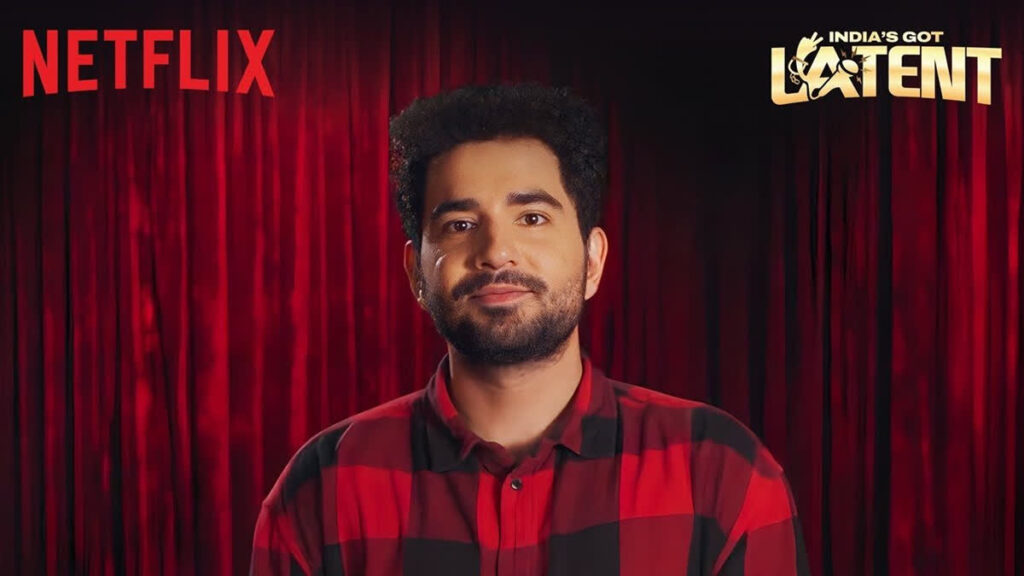
The concluding section of Still Alive is, in some respects, its most consequential. Having survived the FIRs, the financial exposure, the deletion of the show, and the psychological toll of the crisis period, Raina confirmed that India’s Got Latent Season 2 will proceed. He described it as wilder and more unfiltered than its predecessor, and characterised his creative direction going forward as a deliberate move away from seeking mass validation.
This conclusion carries real risk that the special itself does not fully address. The legal proceedings from Season 1 remain unresolved. The regulatory environment for digital content in India has not become more permissive as a consequence of the controversy. A second season positioned as more unfiltered than the first will face scrutiny shaped by the precedent the first season established.
Whether this creative posture reflects genuine artistic conviction, a recalibrated understanding of his core audience, or an underestimation of sustained legal exposure is a question only Season 2’s content and reception will resolve.
What the sold-out international tour that followed the controversy did confirm is that Raina’s relationship with his direct audience proved more durable than his standing in the broader public discourse. In the creator economy, those two things are not the same — and the India’s Got Latent case is now one of the more detailed documented illustrations of the difference.