

Mumbai
A 19th-century oil painting by Raja Ravi Varma has sold for ₹167.2 crore — approximately $17.9 million including buyer’s premium — at Saffronart’s Spring Live Auction in Mumbai, establishing a new record for the highest price ever paid for a work of modern Indian art at auction.
The painting, Yashoda and Krishna, created in the 1890s, was acquired by Cyrus S. Poonawalla, founder of the Serum Institute of India. It was consigned from a New Delhi private collection and carried a pre-sale estimate of ₹80 crore to ₹120 crore. The final hammer price of $15 million — rising to $17.9 million with fees — more than doubled the lower end of that estimate.
In a statement released following the sale, Poonawalla said: “I am privileged to have the opportunity to acquire, preserve, and care for the iconic Raja Ravi Varma painting Yashoda and Krishna. This national treasure deserves to be made available for public viewing periodically, and it will be my endeavour to facilitate this going forward.”
The Work: Subject, History, and Significance
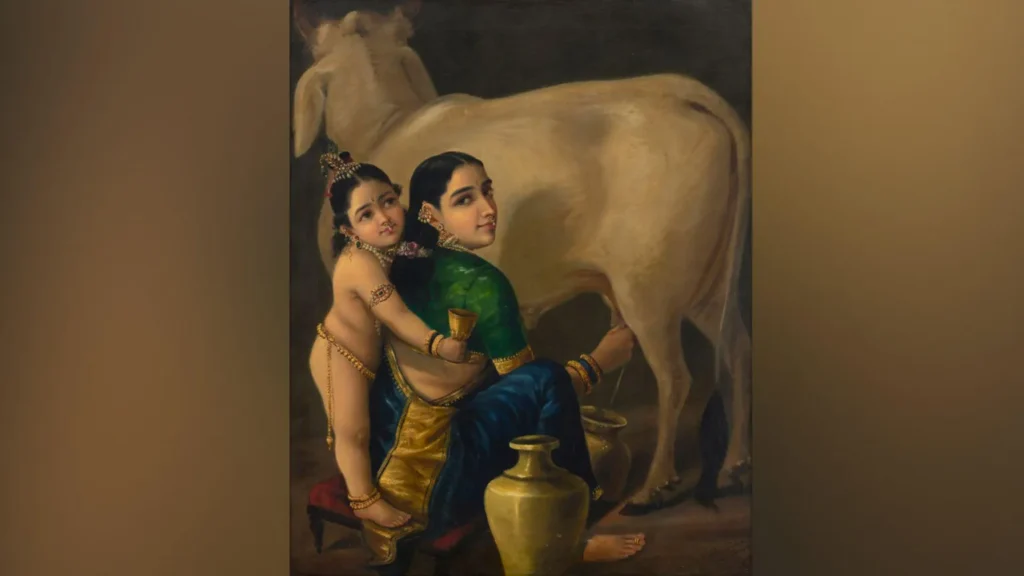
Yashoda and Krishna is an oil on canvas measuring 35 by 28.25 inches. The composition depicts the infant Krishna approaching his foster mother Yashoda as she milks a cow in a pastoral setting — a scene drawn from Hindu mythology that Varma rendered with his characteristic naturalistic technique. The painting is dated to the 1890s, a period widely considered the height of Varma’s career.
The earliest known documented reference to the work appears in S. N. Joshi’s 1911 publication Half-Tone Reprints of the Renowned Pictures of the Late Raja Ravi Varma, where it is listed under the title Milching a Cow. A chromolithograph based on the painting was subsequently printed at the Ravi Varma Press under the title Yashoda Krishna. The work had previously been exhibited by DAG gallery, which has offices in New Delhi, Mumbai, and New York.
Raja Ravi Varma (1848–1906) is widely regarded as the father of modern Indian art. He is among 11 artists designated a “national treasure” under India’s Antiquities and Art Treasures Act of 1972. That designation carries a specific legal consequence: works by these artists cannot be exported from India, meaning the pool of eligible buyers is limited to domestic collectors.
The Record It Broke — and Where It Stands Globally
The sale surpasses the previous auction record for modern Indian art, held by M. F. Husain’s Untitled (Gram Yatra), which sold for approximately ₹118 crore — or $13.7 million with fees — at Christie’s New York in March 2025, less than a year before this transaction.
Yashoda and Krishna is now the highest-priced work of modern Indian art ever sold at auction. It is, however, the second-highest price paid for any work of art from South Asia overall. The record for that broader category remains $24.6 million, paid for a 12th-century black stone figure of a bodhisattva from northeastern India at Christie’s New York in 2017 — a work classified as a historical artefact rather than modern art.
The gap between consecutive Indian auction records — set roughly twelve months apart — indicates an acceleration in valuations at the top end of the market.
Also Read:
The Buyer: Cyrus S. Poonawalla
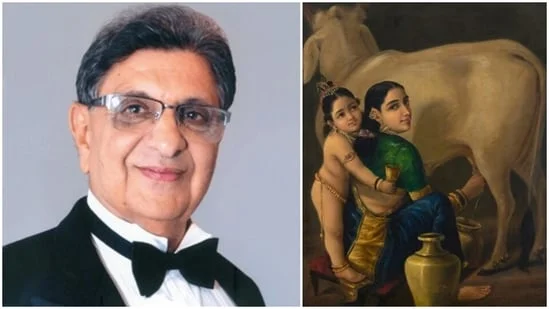
Cyrus S. Poonawalla is the founder and chairman of the Serum Institute of India, the world’s largest vaccine manufacturer by volume. His acquisition of Yashoda and Krishna adds a work of national significance to a collection associated with one of India’s most prominent industrial families. His stated intention to make the painting available for periodic public viewing introduces the possibility of institutional access to what is otherwise a privately held asset, though no specific arrangement has yet been announced or formalised.
Under the national treasure designation, the painting is required to remain within India, which aligns with Poonawalla’s stated commitment to preserving it domestically.
What the Sale Signals for India’s Art Market
The constraints imposed by the national treasure designation have historically been viewed as limiting the market reach of works by artists such as Varma. Because they cannot be sold internationally, their auction prices are determined entirely by the depth of domestic demand.
The Yashoda and Krishna result suggests that domestic demand has grown substantially. Ashish Anand, chief executive of DAG gallery, said in a statement that the price achieved “marks a turning point” for the country’s art market and “further underscores a maturing collector base — one that is both globally competitive and deeply invested in retaining cultural patrimony within India.”
Minal Vazirani, President and Co-founder of Saffronart, described the transaction as “not just a milestone for the market, but a powerful reminder of the enduring cultural and emotional resonance of Indian art.”
Both characterisations represent institutional perspectives from parties with direct involvement in the Indian art market, and should be read in that context. However, the underlying data point — a 42 percent increase in the top auction record for Indian art in under twelve months — is a verifiable indicator of upward market movement at the highest price tier.
The Legal and Cultural Frame
The Antiquities and Art Treasures Act of 1972, which governs the national treasure designation, was originally designed to prevent culturally significant Indian artworks and artefacts from leaving the country following decades of depletion through colonial-era export and private sale. The same legislation that restricts the international circulation of Varma’s works also ensures they remain accessible to the Indian public in principle — though in practice, many nationally designated works remain in private hands with limited public visibility.
Poonawalla’s commitment to periodic public display, if implemented, would represent one way in which private ownership of nationally designated works can be reconciled with the public interest rationale underlying the designation itself. The specifics of that arrangement — which institution would host the work, on what terms, and with what frequency — have not been disclosed.
For the broader Indian art market, the sale of Yashoda and Krishna at this price will likely serve as a reference point in valuations of comparable works by Varma and other nationally designated artists. Whether this result reflects durable demand or the dynamics of a single competitive auction is something that subsequent sales in the category will help clarify.
What the April 1 sale establishes beyond dispute is that Indian collectors are now willing to pay prices for domestically restricted works that are fully competitive with international auction markets — a development with implications for how the national treasure framework, the Indian art trade, and institutional access to cultural heritage may evolve in the years ahead.